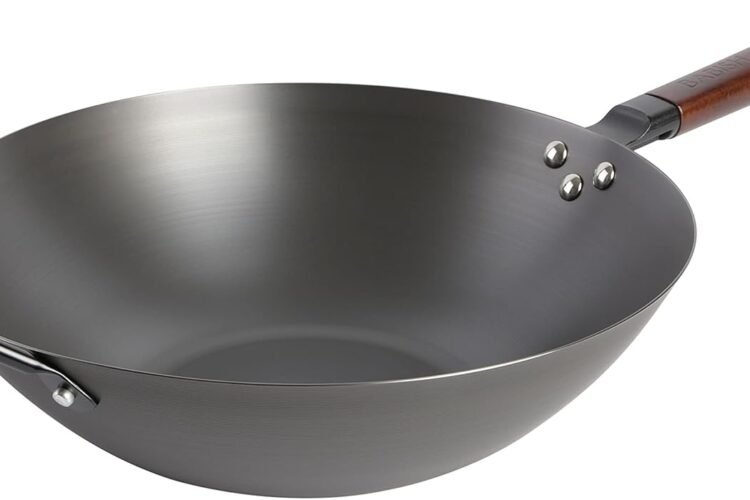
The wok is one of the oldest and most versatile cooking vessels in culinary history. Originating in China and spreading throughout East and Southeast Asia, the wok’s distinctive shape — a wide, rounded base with tall, sloping sides — makes it uniquely suited to a range of cooking techniques that are difficult or impossible to replicate with a standard Western pan. Understanding how a wok works and what it does well can help you decide whether it belongs in your kitchen.
What Is a Wok?
A wok is a round-bottomed (or flat-bottomed, in modern versions) pan with a wide surface area and tall sloping sides. The shape creates a cooking surface with multiple heat zones: the very hot center at the bottom is ideal for high-heat cooking, while the cooler sides allow cooked food to rest while other ingredients are being prepared. Traditional woks are made from carbon steel or cast iron. Modern flat-bottomed woks made from carbon steel or non-stick-coated materials are designed for Western stovetops.
Key Features
- Large surface area: The wide, flared design provides more cooking surface than a standard skillet of similar base diameter.
- Multiple heat zones: The bottom of the wok gets hotter than the sides, which lets you cook at different temperatures simultaneously.
- Lightweight construction: Carbon steel woks are much lighter than cast iron, making them easy to toss and maneuver during cooking.
- Develops seasoning over time: A carbon steel wok develops a natural patina (seasoning) with use, which improves its non-stick properties and flavor.
- Handles: Woks typically have one long handle (Cantonese style) or two small loop handles (Mandarin/pau wok style). Long-handle versions are more common in Western cooking contexts.
How a Wok Can Be Used
Stir-Frying
This is the technique most associated with the wok. Stir-frying involves cooking ingredients quickly over very high heat while constantly moving them around the pan. The wok’s shape makes it ideal for this, allowing food to be tossed up the sides and back down into the heat.
Deep Frying
The wok’s depth and wide opening make it practical for deep frying, requiring less oil than a flat-bottomed pot of similar capacity.
Steaming
A wok with a dome lid and a bamboo or metal steamer basket can be used as a steaming vessel for dumplings, fish, or vegetables.
Braising and Simmering
Despite its association with dry, high-heat cooking, a wok with a lid can also be used for braising or simmering dishes.
Smoking
A wok can be converted into a stovetop smoker using wood chips, sugar, or tea leaves placed in the bottom beneath a rack. This technique is used in Chinese cooking for smoked duck, fish, and other proteins.
Who Might Benefit from a Wok
- Anyone who enjoys Asian cooking or stir-fry dishes
- Cooks who want to replicate high-heat restaurant-style cooking at home
- Those looking for a single pan that handles stir-frying, steaming, deep frying, and braising
- Cooks with a gas stove who can achieve the high heat that makes wok cooking most effective
Carbon Steel vs. Cast Iron Wok
- Carbon steel: The most traditional and widely recommended choice. Lightweight, heats up quickly, and develops a good natural seasoning with use. Requires some care to prevent rust.
- Cast iron: Heavier, holds heat longer, but slower to heat up and difficult to toss food in due to weight. Traditional in some Chinese regional cuisines but less practical for most home use.
Wok for Western Stovetops
Traditional round-bottomed woks require a ring support on a gas burner or a specialized wok burner to sit stably. Flat-bottomed woks are designed to work on standard gas, electric, and induction stovetops without additional accessories. For home cooks with standard Western stoves, a flat-bottomed wok is the more practical option, though purists note that the heat distribution differs from a true round-bottomed wok on a high-BTU burner.
Frequently Asked Questions
Do I need a wok if I have a large skillet?
A large skillet can handle some stir-fry tasks, but the wok’s shape offers advantages in tossing food, managing multiple heat zones, and cooking in larger quantities without overcrowding. For dedicated stir-frying, a wok performs more effectively.
How do I season a carbon steel wok?
The initial seasoning involves scrubbing off the factory protective coating, then heating the wok over high heat while rubbing oil into the surface and allowing it to polymerize. The wok should be wiped with a thin layer of oil after each use to build up seasoning over time.
Can I use a wok on an induction cooktop?
Standard round-bottomed woks do not work on induction cooktops because they cannot sit flat. Flat-bottomed carbon steel woks that are induction-compatible can work, though the heat distribution may differ from a gas flame.
Conclusion
A wok is one of the most functional and underutilized pieces of cookware in Western kitchens. For those who enjoy stir-frying, Asian cuisine, or simply want a highly versatile, fast-heating pan, a carbon steel wok is a practical and rewarding addition. Like cast iron, it requires some care but improves with use and, when maintained properly, can last for many years. You can check more details and current options on Amazon here.