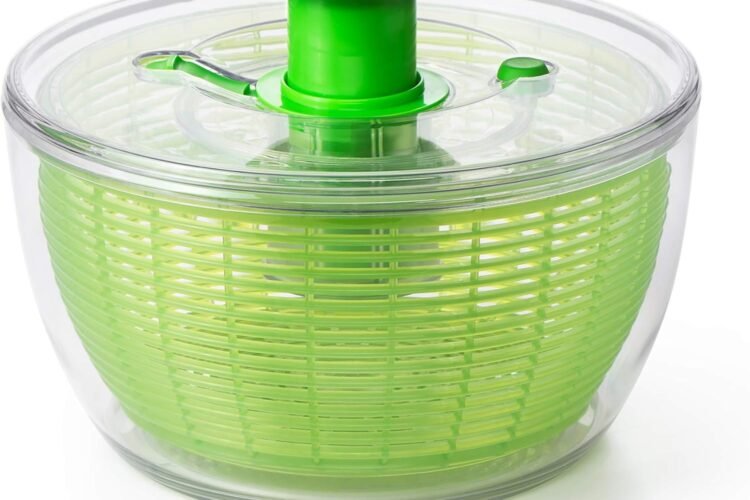
A salad spinner might seem like a single-purpose gadget, but for those who eat salads or cook with leafy greens regularly, it earns its counter space quickly. Wet greens dilute dressings, steam-cook rather than roast in a hot pan, and wilt faster in the refrigerator. A salad spinner removes excess water efficiently and prepares greens for better storage, better-dressed salads, and more effective high-heat cooking.
What Is a Salad Spinner?
A salad spinner consists of a bowl, an inner basket, and a spinning mechanism (typically a lid with a push-button, pull-cord, or hand-crank mechanism). Washed greens are placed in the inner basket. When the mechanism is activated, centrifugal force pushes water outward through the holes in the basket and into the outer bowl. The water collects in the bowl and can then be poured off, leaving the greens dry.
Why Dry Greens Matter
- Better-dressed salads: Water on lettuce leaves repels oil-based dressing, causing it to bead off rather than cling evenly. Dry greens hold dressing much more effectively.
- Longer storage: Excess moisture accelerates the wilting and decay of leafy greens. Dried greens wrapped in a paper towel and stored in the refrigerator (or in the salad spinner bowl itself) stay fresh significantly longer than wet greens.
- Better cooking results: When cooking greens like spinach or kale in a hot pan, excess water steams them rather than allowing them to sauté properly. Dry greens sear and wilt more cleanly.
Key Features
- Bowl capacity: Ranges from small personal-size spinners to large models that accommodate a full head of lettuce. A 5-quart or larger capacity is practical for most households.
- Spinning mechanism: Push-button centrifuge lids are popular for being easy to operate with one hand. Pull-cord and hand-crank designs are also effective. The key is a mechanism that spins smoothly and stops reliably.
- Stability: A non-slip base prevents the spinner from moving across the counter during use.
- Ease of cleaning: Some lids are fully submersible and dishwasher safe; others have mechanisms that make cleaning more involved. Simpler designs are generally easier to maintain.
- Dual-use bowl: Many salad spinners can be used as a serving bowl as well, reducing dishes.
What Else a Salad Spinner Can Do
Beyond lettuce, a salad spinner is useful for:
- Washing and drying fresh herbs (parsley, cilantro, basil)
- Rinsing and drying berries
- Draining rinsed canned beans
- Washing and drying other delicate produce
Who Benefits Most
- Those who eat salads regularly and want properly dressed greens
- Anyone who uses fresh herbs frequently in cooking
- Cooks who sauté greens like spinach or kale and want better results from the pan
- Households that buy fresh leafy greens and want them to last longer in the refrigerator
Frequently Asked Questions
Can I wash greens ahead of time and store them in the salad spinner?
Yes — many people wash, spin, and store greens directly in the salad spinner bowl in the refrigerator. This keeps greens accessible and extends their freshness by several days compared to storing them wet.
Does a salad spinner get greens completely dry?
A salad spinner removes most surface water effectively, but some residual moisture may remain. For applications where completely dry greens are critical, patting them with a clean kitchen towel after spinning provides extra dryness.
Are expensive salad spinners worth it?
Quality spinners tend to have more durable mechanisms, smoother spinning action, and better-fitting lids that seal properly. For regular use, a mid-range or higher-quality spinner is generally a worthwhile investment over cheaper alternatives that may wobble or break quickly.
Conclusion
A salad spinner is an underappreciated kitchen tool that delivers practical value well beyond its apparent simplicity. For anyone who eats salads, cooks with fresh greens, or wants to extend the life of their produce, it is a useful and efficient addition to the kitchen. You can check more details and current options on Amazon here.