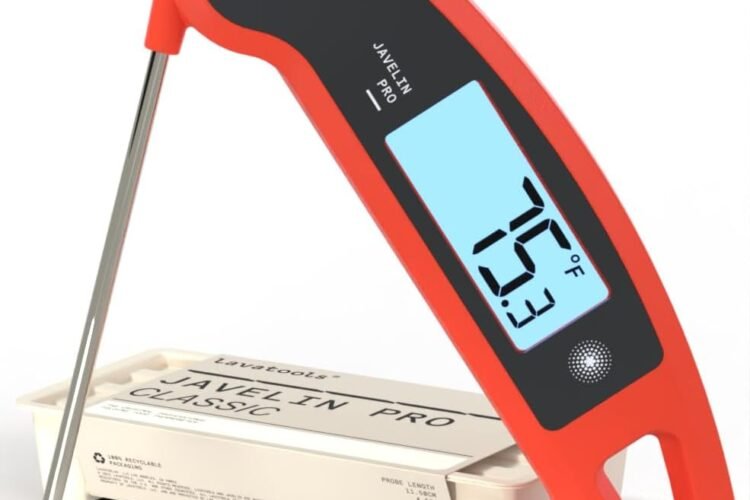
An instant-read thermometer is one of the most straightforward ways to improve your cooking accuracy and food safety simultaneously. Guessing when meat is done by sight, touch, or timing alone introduces uncertainty — a thermometer removes that uncertainty entirely. Whether you are cooking a whole chicken, a beef roast, pork tenderloin, or even tempering chocolate, accurate temperature measurement makes the difference between a perfectly cooked result and an over- or underdone one.
What Is an Instant-Read Thermometer?
An instant-read thermometer is a handheld device with a probe that you insert into food to get a temperature reading in seconds. Unlike leave-in probe thermometers that remain in the food during cooking, instant-read thermometers are used for spot-checking — you insert, read, and remove. Most modern instant-read thermometers give accurate readings in two to five seconds.
Key Features
- Reading speed: Quality instant-read thermometers display an accurate temperature in 2–4 seconds. Slower models (10+ seconds) can be frustrating to use and may give less accurate readings if the probe is moved during the reading.
- Accuracy: Look for thermometers accurate to within ±1°F or ±0.5°C. Many quality models are accurate to ±0.9°F.
- Temperature range: A range of at least -40°F to 572°F (-40°C to 300°C) covers the full spectrum of kitchen and grill use.
- Rotating or folding probe: A probe that rotates 180 degrees allows right-handed and left-handed users to read the display comfortably from different angles.
- Backlit display: Useful when checking temperatures on a dark grill or in a dimly lit oven environment.
- Water resistance: A water-resistant or waterproof thermometer is easier to clean and more durable in kitchen conditions.
- Auto shut-off: Preserves battery life when the thermometer is not in use.
Safe Minimum Internal Temperatures (USDA Guidelines)
Food safety is one of the most important reasons to use a thermometer. The following are general safe minimum internal temperatures according to USDA guidelines:
- Poultry (whole, parts, ground): 165°F (74°C)
- Ground meats (beef, pork, lamb): 160°F (71°C)
- Beef, pork, lamb, veal (roasts, steaks, chops): 145°F (63°C), with a 3-minute rest
- Fish and shellfish: 145°F (63°C)
- Egg dishes: 160°F (71°C)
Always verify current guidelines with the USDA Food Safety and Inspection Service for the most up-to-date recommendations.
How It Can Be Used
Meat and Poultry
The primary use. Insert the probe into the thickest part of the meat, away from bone and fat, to get an accurate reading of the internal temperature.
Candy and Chocolate Making
Sugar and chocolate work depend on precise temperature control — the difference between soft-ball and hard-crack candy stages, or between tempered and untempered chocolate, comes down to just a few degrees.
Bread Baking
Bread is done when the internal temperature reaches approximately 190–210°F (88–99°C) depending on the style. A thermometer takes the guesswork out of evaluating doneness.
Deep Frying
Monitoring oil temperature is essential for proper frying. Too cold and food absorbs excess oil; too hot and it browns before cooking through. Most frying occurs between 325°F and 375°F (163–190°C).
Beverages and Dairy
Heating milk to the correct temperature for coffee drinks, tempering eggs for custard, or scalding milk for bread dough all benefit from precise temperature monitoring.
Who Benefits Most
- Anyone who regularly cooks meat or poultry and wants to ensure both safety and optimal doneness
- Bakers working with candy, chocolate, or bread baking
- Grill enthusiasts who want to achieve precise steak doneness consistently
- Those who deep fry and need to monitor oil temperature
Frequently Asked Questions
Where should I insert the probe for an accurate reading?
Insert the probe into the thickest part of the food, away from bones, fat, or gristle. For whole poultry, the inner thigh area near the bone (but not touching it) is the recommended location. The probe tip is the sensing element, not the entire probe length.
How do I calibrate my thermometer?
The simplest calibration method is the ice water test: fill a glass with ice water, insert the probe, and check that the reading is 32°F (0°C). Many digital thermometers have a calibration adjustment function. Refer to the manufacturer’s instructions.
Is an instant-read thermometer the same as a leave-in probe thermometer?
No. An instant-read thermometer is used for spot-checking and removed between readings. A leave-in probe thermometer connects to a base unit with a cable and stays in the food during cooking, often with an alarm that sounds when the target temperature is reached. Both are useful but serve different purposes.
Conclusion
An instant-read thermometer is one of the highest-value, lowest-cost tools available to home cooks. It improves food safety, takes the guesswork out of meat doneness, and provides precision for candy making, bread baking, and frying. For any cook who prepares meat, poultry, or temperature-sensitive preparations, it is close to essential. You can check more details and current options on Amazon here.