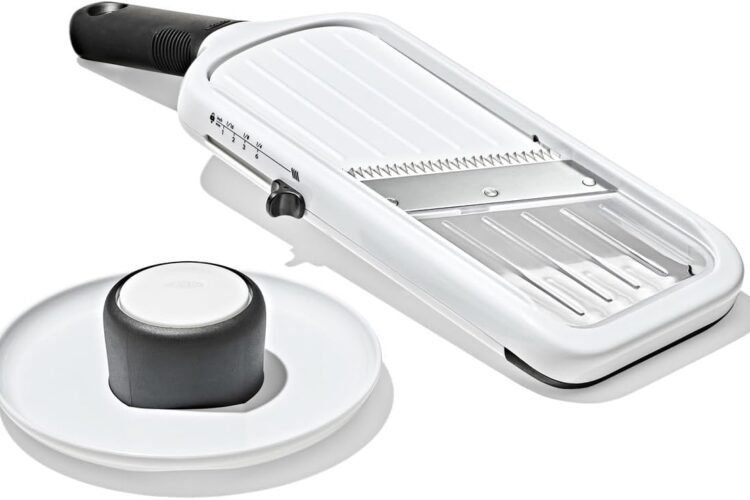
A mandoline slicer is a kitchen tool that produces uniform, thin slices of vegetables and fruits with a speed and consistency that is very difficult to achieve by hand. For certain tasks — paper-thin cucumber slices, perfectly even potato rounds for a gratin, uniformly shredded cabbage for coleslaw — it is essentially unmatched. But it is also a tool that requires respect and the right safety equipment. This guide covers what a mandoline is, how it can be used, what to look for, and the safety precautions that are essential when using one.
What Is a Mandoline Slicer?
A mandoline slicer is a kitchen device with one or more sharp blades mounted in a flat frame. Food is held and slid across the blade repeatedly to produce consistent slices. The thickness of each slice is typically adjustable, ranging from paper-thin to several millimeters thick, depending on the model. Some mandolines also include interchangeable blades for julienne cuts, waffle cuts, or grating.
Key Features
- Adjustable slice thickness: Most mandolines allow you to set the thickness of each slice, often ranging from less than 1mm to 9mm or more.
- Interchangeable blades: Many models include multiple blade inserts for julienne cuts, crinkle cuts, and different slice thicknesses.
- Folding design: Some mandolines fold flat for easier storage.
- Non-slip feet or stand: Stability during use is important. Quality mandolines include non-slip feet and some include a folding stand for use at a comfortable angle over a bowl.
- Food holder/safety guard: A hand guard or food holder is included with most mandolines to allow safe slicing without putting fingers near the blade.
How a Mandoline Slicer Can Be Used
Gratins and Layered Dishes
Thin, uniform potato slices for potato gratin or scalloped potatoes are one of the most classic mandoline applications. Consistent thickness ensures even cooking throughout the dish.
Salads
Paper-thin slices of fennel, radish, cucumber, beets, and similar vegetables add visual appeal and a distinctive texture to salads that thick slices cannot replicate.
Coleslaw
Cabbage can be sliced or shredded quickly and evenly using a mandoline, producing a fine, consistent texture for coleslaw.
Fruit Preparations
Uniform apple or pear slices for tarts, thin citrus slices for garnishes, or even sliced strawberries for desserts can all be prepared efficiently with a mandoline.
Chips
Very thin vegetable slices (potato, zucchini, beet) can be produced for baking or frying into chips at home.
Safety — The Most Important Consideration
A mandoline slicer has an exceptionally sharp blade. It is considered one of the most dangerous tools in the kitchen, and injuries from mandoline use — particularly to fingers — are surprisingly common. This is not a reason to avoid the tool, but it is a reason to use it with full attention and proper protective equipment.
Essential safety practices:
- Always use the included food holder or safety guard when slicing. Never run food past the blade with bare fingers.
- Invest in a pair of cut-resistant gloves designed for kitchen use. These are widely available and significantly reduce the risk of cuts.
- Keep your focus entirely on the task. Mandoline injuries often occur when attention is divided.
- Slow down as the food item gets smaller. The final piece is where most injuries occur.
- Store the mandoline safely when not in use — in a sleeve, bag, or with blade covers in place.
Mandoline vs. Food Processor for Slicing
- A mandoline produces thinner, more precise slices than most food processor disc attachments, and is easier to set up for quick slicing tasks.
- A food processor is better for slicing large quantities quickly, particularly when the volume outweighs the benefit of ultra-thin precision.
Who Benefits Most
- Cooks who frequently prepare dishes that require uniform thin slices (gratins, salads, tarts)
- Those who make homemade chips or crisps regularly
- Anyone who wants to elevate the presentation of vegetable and fruit dishes
- Cooks who do high-volume prep work and want to reduce the time spent slicing
Frequently Asked Questions
Can I slice meat on a mandoline?
Firm, chilled meat can be sliced on a mandoline, but this is not a common application for home kitchens. Most mandoline blades are designed for firm produce. Always check the manufacturer’s guidelines for the specific model.
How do I clean a mandoline safely?
Clean a mandoline carefully by hand — never reach across the blade with a bare hand. Use a brush or sponge to clean around the blade from the side, not directly across it. Dry immediately to prevent rust on carbon steel blades.
Are inexpensive mandoline slicers worth buying?
Entry-level mandolines can perform adequately for basic slicing tasks. The main concerns with cheaper models are build quality, stability during use, and blade sharpness. A mid-range model with solid build quality and good safety features is generally the most practical choice for regular home use.
Conclusion
A mandoline slicer is a genuinely useful kitchen tool for those who regularly prepare dishes that require uniform, thin slices. When used with proper safety precautions — particularly cut-resistant gloves — it is a safe and efficient addition to the kitchen. For gratins, salads, tarts, and similar preparations, it produces results that are difficult to achieve by hand with the same consistency and speed. You can check more details and current options on Amazon here.